Bottom line
HVAC owners in Cleveland, Akron, and Canton are asking the same question: can an AI answering service actually handle emergency calls without losing customers?
Short answer: yes, but only if the emergency escalation flow is tested. The cheap vendors skip that step and it shows the first time someone calls with no heat at 11pm in January.
Real cost for most HVAC operations is $150 to $500 a month. Compare that to a live dispatcher at around $45,000 a year and the math is obvious — but the details matter more than the price.
Why HVAC owners are switching to AI answering services
Heating and cooling calls go cold fast. When a customer's AC quits in July or their furnace dies in a cold snap, they call until someone answers. If your phone hits voicemail three times in a row, the fourth call is to your competitor. That job is gone.
The scale of the problem is bigger than most owners realize. Industry benchmarks from Contractor Magazine and Service Roundtable (compiled in the AgentZap HVAC phone statistics review) show that the average HVAC contractor misses about 22% of incoming calls and that 62% of HVAC calls come outside regular business hours. Emergency service calls command 2× to 3× the ticket value of routine service — and those are exactly the calls most likely to go unanswered.
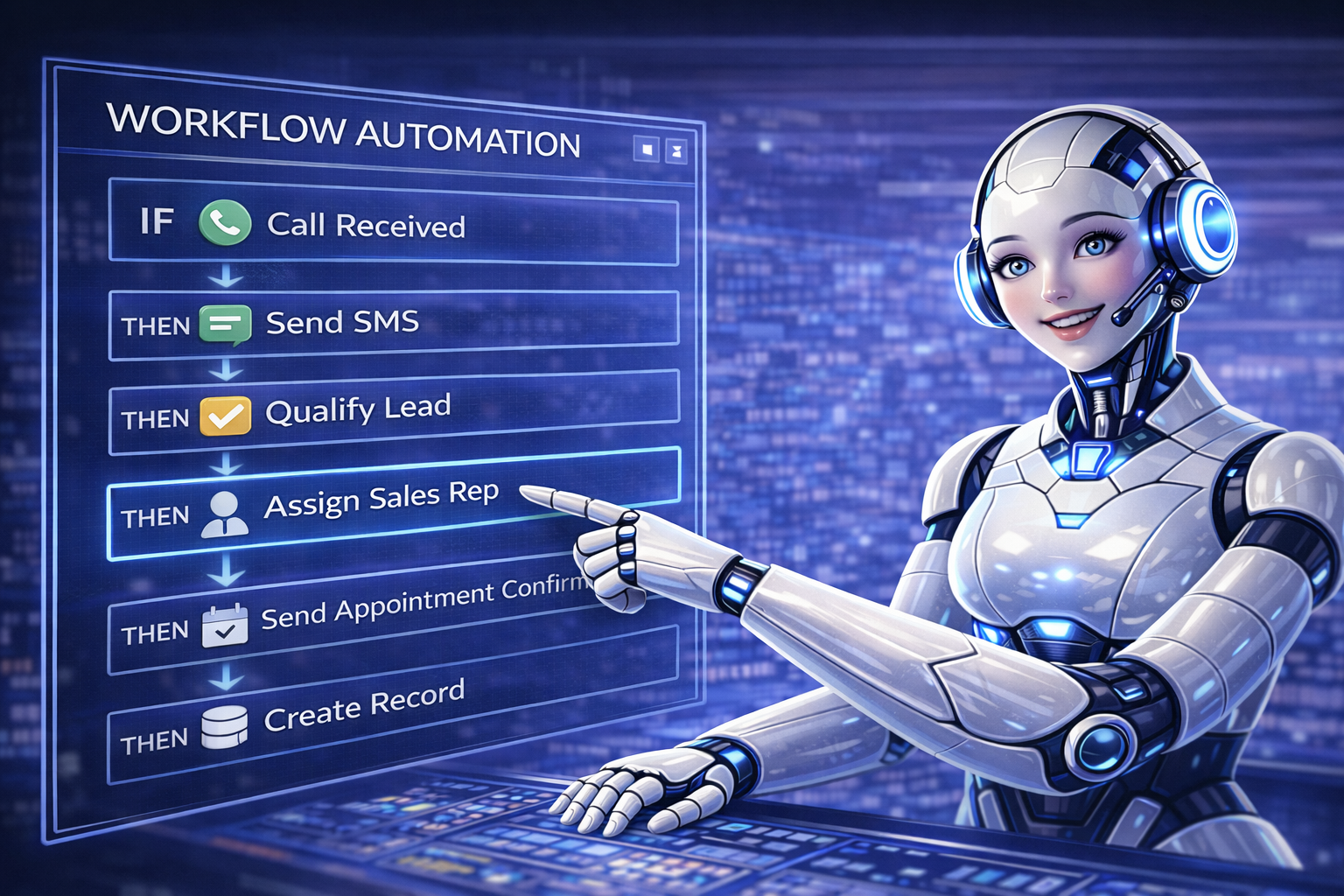
An AI answering service closes that gap. It picks up on the first ring, 24/7. It captures the customer's name, address, and the nature of the emergency. It routes urgent calls to the on-call tech and takes messages for the non-urgent ones.
Using the numbers from the AI Robot Builds Missed Call Revenue Leak Calculator — 5 missed HVAC calls a week, 50% real opportunities, 25% close rate, $750 average job — that's around $938 a week in lost revenue, or about $48,750 a year. Fixing even half of that pays for the top-tier AI plan several times over. Independent home-services research from Invoca puts the average lost revenue per missed call around $1,200, so for high-ticket HVAC operations the real number is often much higher.
What this looks like for a typical Northeast Ohio HVAC business
Take a mid-size Cleveland or Akron HVAC operation running 3 to 5 trucks with 400 to 600 calls a month. At a 22% miss rate, that's about 90 to 130 missed calls a month. If just 30% of those are emergency-tier calls at $450+ average ticket, that's roughly $12,000 to $17,000 a month in lost emergency revenue alone — before you count routine service. During a heat wave or cold snap the miss rate climbs to 50%+ and the ticket value climbs with it. That's the math we walk through with local HVAC operators who book a free AI workflow assessment.
What an AI answering service actually does for an HVAC business
Handles the routine questions
- "What are your hours?"
- "Do you service my area?"
- "Do you install carrier / trane / lennox?"
- "Can you do maintenance plans?"
These calls tie up an office manager for hours a week. AI handles them zero-touch and only escalates when it's an actual service request.
Captures emergency callback info
For urgent calls — no heat, no AC, water leak, gas smell — the AI collects name, phone, address, and the nature of the emergency, then routes straight to the on-call tech instead of dropping into voicemail.
Books non-urgent appointments
Modern AI answering services integrate with dispatch software like ServiceTitan, Housecall Pro, and Jobber. The AI checks the calendar, offers real openings, and confirms the appointment by SMS.
Screens out the noise
Every HVAC owner in Ohio knows the equipment supplier pitch calls, the extended warranty scams, and the political survey robots. AI catches those before they hit your line.
The emergency-call gotcha most vendors won't tell you
This is the single most important thing to test before buying. Not every AI answering service can identify a real HVAC emergency fast enough. Bad emergency routing is not a small problem — it means frozen pipes, no-heat calls to elderly customers in January, and in the worst cases, gas leaks that don't get flagged.
Ask any vendor: "Show me the emergency escalation flow."
What a good escalation flow looks like:
- Caller says something like "no heat," "no AC," "water leaking," or "smell of gas"
- AI recognizes the emergency phrase within 3 seconds
- Skips voicemail entirely and dials the on-call tech directly
- Sends SMS backup to the tech AND to the owner
- Logs the call for morning follow-up
If a vendor can't demo that end-to-end, don't sign. This one screen matters more than any other feature.
HVAC-specific features to look for
Dispatch software integration
- ServiceTitan native integration — premium tier, but worth it for multi-truck operations
- Housecall Pro native — solid mid-market fit
- Jobber, ServiceFusion — supported by most vendors, works well for smaller shops
- Zapier-only — works, but adds 30 to 60 seconds of lag on the handoff
Skill-based routing
Not every tech handles every call. AI answering services can route residential vs. commercial, refrigeration vs. HVAC, and new-install vs. service calls to different techs.
Bilingual support
Big deal in a lot of Ohio markets. Some AI answering services handle English/Spanish handoff natively; others charge extra for it.
Seasonal call pattern learning
Good AI answering services adjust escalation urgency by weather and season. July heat wave means every "no cool" call moves to the top of the queue. January cold snap does the same for "no heat" calls.
Real pricing for HVAC operators
- Small residential shop (under 100 calls a month): $150 to $250 a month
- Mid-size operation (100 to 500 calls a month): $300 to $500 a month
- Multi-truck or commercial (500+ calls a month): $600 to $1,200 a month
- Setup: $500 to $1,500 depending on how deep the dispatch integration goes
Compare that to a live dispatcher at $45,000+ a year. Even the top-tier AI plan covers 24/7 for less than 15% of that cost. And you keep the human dispatcher for the daytime peak — the AI handles nights, weekends, and overflow.
When AI answering service ISN'T enough
Straight talk. AI answering services are great for the first 60 seconds of a call. They're not good at:
- Full dispatch replacement — routing techs by location, live traffic updates, load balancing across multiple crews. You still need a human dispatcher during peak hours.
- Complex commercial job quoting — commercial estimates need a human with equipment pricing knowledge.
- Insurance and warranty disputes — sensitive customer conversations should stay human.
The right frame: AI handles the first 60 seconds. A human handles the complex work.
Realistic setup timeline
Anyone promising 24-hour setup is skipping the part that matters. Here's what a real setup looks like:
- Days 1 to 2: Discovery call, dispatch software audit, script planning
- Days 3 to 7: Custom script writing, voice selection, brand tuning
- Days 8 to 10: Integration testing with dispatch software
- Days 11 to 14: Shadow mode — the AI listens on real calls while humans still answer, so you can catch scripting mistakes before customers hear them
- Day 15+: Go live with AI as the primary answer
Expect about 2 weeks from signature to live. Shorter than that and you'll be debugging scripts on live customer calls.
FAQ
Can an AI answering service dispatch emergency HVAC calls?
Yes — but only if the emergency escalation flow is tested end-to-end. Ask the vendor for a live demo with the exact emergency phrases your customers use ("no heat," "no AC," "water leak"). If they can't show it working, don't sign.
Will an AI receptionist mess up my customer relationships?
Not if the script is written in your voice. Modern voices are natural enough that most callers don't notice it's AI. The ones who do usually appreciate that someone answered instead of hitting voicemail.
How does AI answering integrate with ServiceTitan or Housecall Pro?
Most modern AI answering services have native integrations or work through Zapier. Ask about specific fields the AI can pass through: customer name, phone, service address, urgency flag, and callback preferences. Anything short of that means data entry work for your team.
What if the AI can't understand my customer?
Modern AI answering services route to a live human backup, either at the vendor or through your team's on-call rotation. Ask about their handoff process — some charge per handoff, some don't, and the quality varies a lot.
Is AI answering worth it for small HVAC shops?
If you're missing more than about 5 calls a week and your average job is $500 or more, yes — the numbers usually work in the first 60 days. Use the missed call revenue leak calculator with your own numbers to check.
Bottom line for HVAC owners
Real cost for most Cleveland, Akron, and Canton HVAC operations is $150 to $500 a month. Best fit is after-hours and overflow coverage — not full dispatch replacement. The single non-negotiable feature is a tested emergency escalation flow. Anything else can be added later.
AI Robot Builds sets up AI receptionist workflows for HVAC companies across Northeast Ohio, built around human-approved rules and clear escalation. If you want a straight quote based on your call volume and dispatch software, book a free AI workflow assessment.